
Search Hurricane Voter Status
Utah's Search by voter information tool is the first stop for a Hurricane voter checking an individual record. It is an authenticated lookup, not a public browse screen. Enter the first and last name, the date of birth, and the reCAPTCHA token. Each item is required. The date of birth helps prove that the searcher is tied to the record; it is not displayed as a public result field. JavaScript must be on, and the live form offers no county filter, export button, voter list, or reset control.
The official Hurricane voter registration lookup uses the following fields:
| Lookup label | Control | Required | How it works |
|---|---|---|---|
| Hurricane First Name | Text | Yes | The Hurricane application marks this field required. |
| Hurricane Last Name | Text | Yes | The Hurricane application marks this field required. |
| Hurricane Date of Birth | Masked date text | Yes | Authenticates the Hurricane voter and is not a public result field. |
| Hurricane reCAPTCHA | Challenge/token | Yes | The Hurricane form cannot submit without a valid token. |
Use the separate Hurricane Search by Address mode when the goal is Hurricane polling-place, ballot, or elected-official information for a location. It does not retrieve a personal registration record. If the authenticated lookup fails or shows an issue, the next step is the Washington County Elections office in St. George, which administers Hurricane voters.
The official Utah voter search shows the exact input screen used for an individual check.
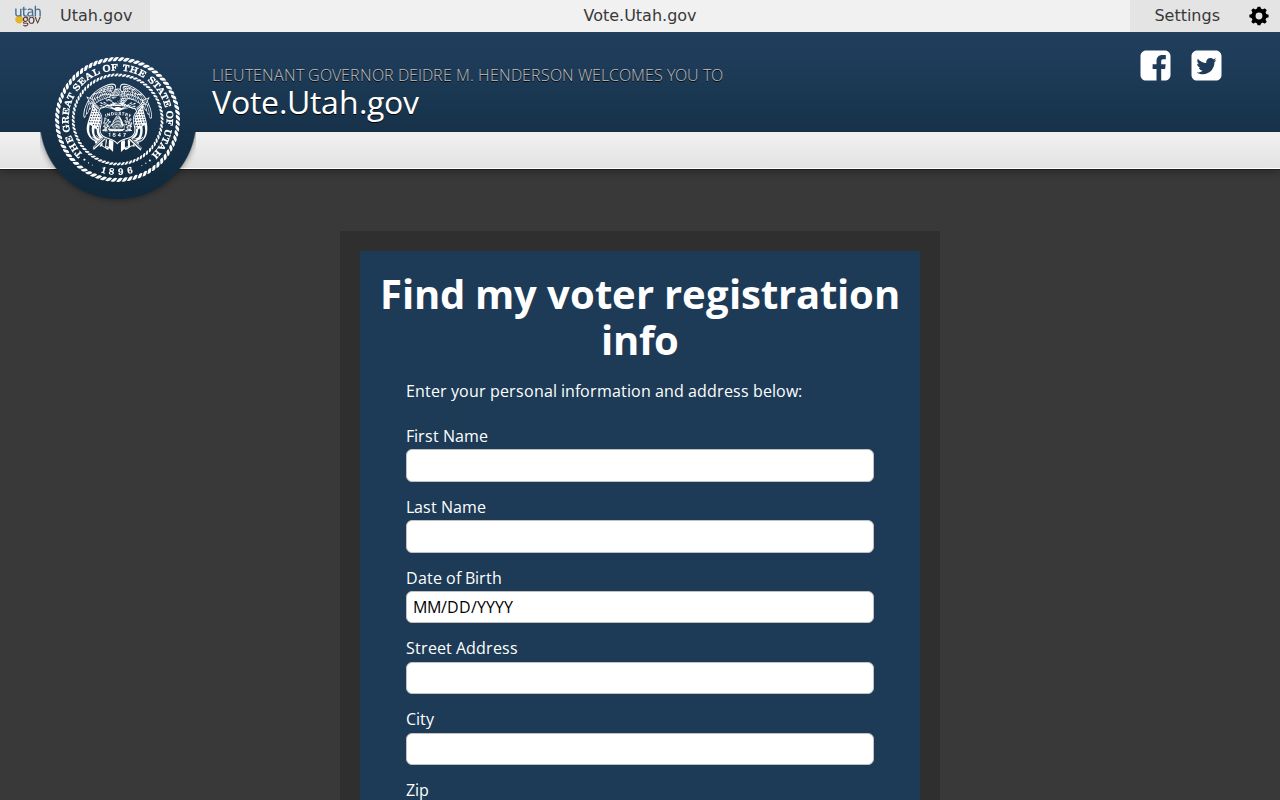
This view makes the key limit plain: a searcher must authenticate one voter rather than scan everyone registered in Hurricane.
Inside a Hurricane Voter Match
An authenticated match gives a Hurricane voter a working election profile. The result layout can show the person's name, physical address, mailing address, precinct, State House voting district, voter identification number, party affiliation, and status when a status message applies. The tool also supports ballot tracking, elected-official details, sample ballots, candidate and issue information, and polling-place information. Those functions help a voter check a current election without turning the screen into an open directory.
The observed result labels form a practical inventory:
| Hurricane Name | Hurricane first and last name, with a middle name when present. |
|---|---|
| Hurricane Physical Address | Hurricane street, unit type and number, city, state, and ZIP. |
| Hurricane Ballot Mailing Address | A separate Hurricane mailing address, or the physical address when both are the same. |
| Hurricane Election Geography | Hurricane voting precinct and State House voting district. |
| Hurricane Registration Details | Hurricane voter ID number, party affiliation, and conditional voter status. |
No private Hurricane voter credentials were used during research, so exact Hurricane non-match messages and all authenticated tabs were not observed. That restraint matters. Searchers should use their own details and contact the clerk when the screen does not resolve a record.
Note: The Hurricane individual lookup and a purchased Hurricane voter file serve different needs, and access to one does not grant access to the other.
Utah Voter Records in 2026
Utah changed the legal definition of public Hurricane voter data in 2026. Current Utah Code Title 20A, Chapter 2, Part 6 defines the standard Hurricane data that may be released for a public registered voter. It includes the full legal name, voter ID and geographic code, age range, residential and mailing addresses, county, party or unaffiliated status, active or inactive status, the last update date, election districts, and voting history. The districts can include congressional, State House, State Senate, state school board, local school board, county council, and city council areas.
That 2026 definition is the right source for Hurricane voter records. Older summaries may say that year of birth is public, but current law uses an age range instead. Utah GRAMA classifies standard voter data as public under Section 63G-2-301(2)(k), subject to the limits in the election code. The broader framework for other government files is summarized in the Hurricane public records search.
Confidential under Utah law. Section 63G-2-302(1)(j) protects a driver's-license or state-ID number, Social Security number or last four digits, email, full birth date, phone number, citizenship proof, proof-status fields, federal-ballot limitation, and an at-risk voter's record and supporting evidence.
Protected Hurricane Voter Records
Some Hurricane voter records are not released with public voter data. Utah's at-risk status may cover qualifying victims or likely victims of domestic or dating violence, law-enforcement officers, people protected by certain court orders, some remotely deployed military members and qualifying family, certain public figures, and qualifying members of their households. For these voters, identity is withheld from the public, political parties, and candidates.
A Hurricane voter who may qualify should use Utah's current registration and privacy information and speak with the Washington County clerk. The crawlable state page directs Hurricane applicants to the county clerk because a direct current designation-form URL was not available. An older 2023 withholding form predates the 2026 law and should not be treated as the current form. Protected Hurricane voters can still view their own records through the official channels.
Note: At-risk status is a statutory protection, not a general opt-out from all government records connected to a Hurricane resident.
Washington County Voter Requests
Hurricane is not the county seat. Its voter rolls are administered by the Washington County Clerk/Auditor at 111 East Tabernacle Street, St. George, UT 84770, phone 435-301-7248 and email elections@washco.utah.gov. The county is the key fallback when the personal lookup needs correction or when a requester needs a county or district subset. The Lieutenant Governor provides the statewide product only. That state-versus-county split keeps a local Hurricane request from becoming an unnecessary statewide purchase.
The county's Elections Department publishes its office and Hurricane election services. Contact the office before relying on the older Hurricane voter-information PDF because the manifest's direct form URL returned an error during capture. A caller can confirm the current form, permitted purpose, available geographic cut, charge, and delivery route without guessing.
The Washington County elections page is the current office entry point for Hurricane registration questions.
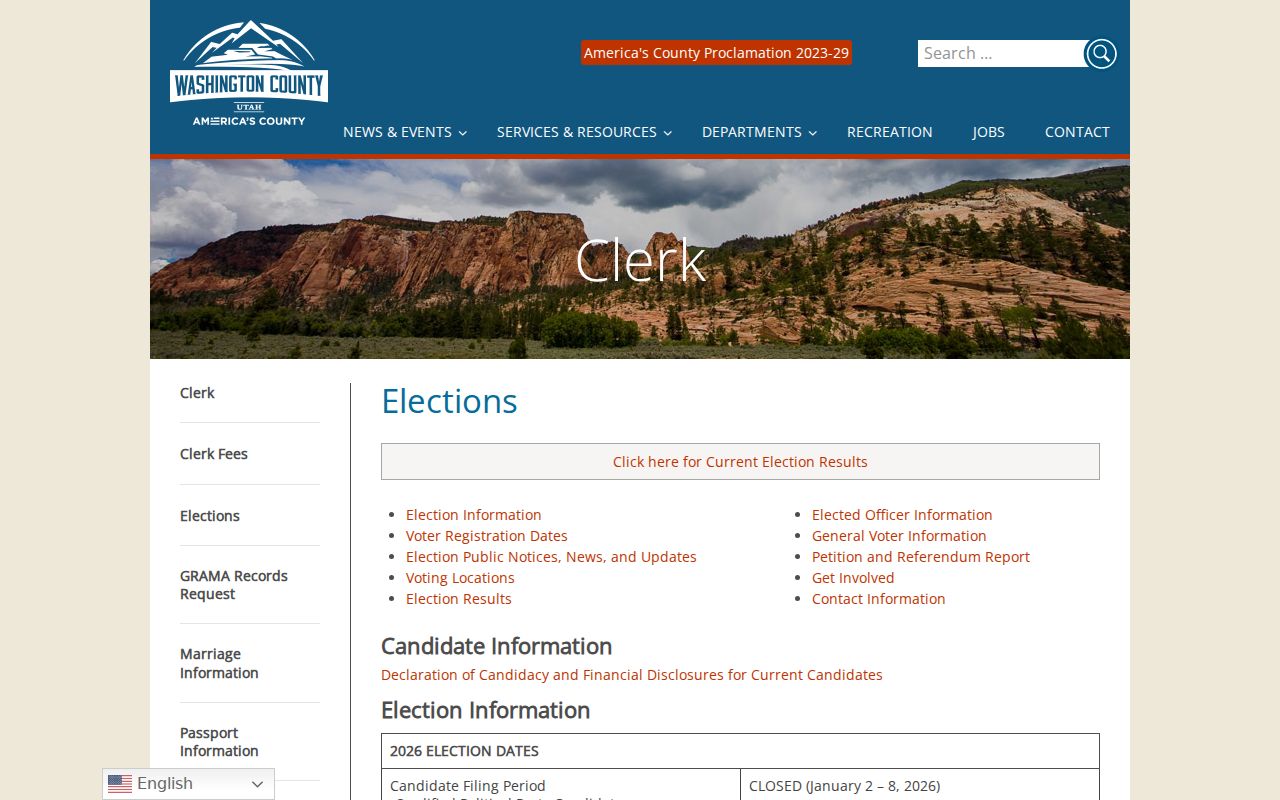
The office route matters because a Hurricane-specific total was not published in the official crawlable statistics, and county totals should not be recast as city figures.
Get the Utah Voter File
The Utah voter-data request page lists the statewide database at $1,050 for a one-time purchase. There are no refunds, subscriptions, or free updates. The file is tab-delimited, about 150 MB, and delivered through an emailed download link within one business day. It contains standard data for public voters, including Hurricane entries, but excludes protected identities and other private fields. The state submission endpoint timed out during research, so its live payment widgets were not verified.
Obtaining the file follows a short, regulated path:
- Choose the Hurricane keeper. Ask the Lieutenant Governor for the statewide database containing Hurricane entries. Ask Washington County for a Hurricane-area county or district subset.
- State the Hurricane purpose. Certify a political purpose, another Hurricane use expressly allowed in Part 6, or a use authorized by state or federal law or court order.
- Accept Hurricane controls. Use industry-standard security for Hurricane data and limit access to authorized agents.
- Receive the Hurricane data. The state product containing Hurricane entries uses the published one-time price and tab-delimited delivery terms.
The official state page also offers two $35 Hurricane election reports. “Who Has Voted” and “Who Has Been Sent an Absentee Ballot” are available during regular even-year primary and general elections, not odd-year municipal elections and not after the election. Each Hurricane report is emailed daily in tab-delimited form during its stated period. Recent precinct-level results are available through the same request route at no fee.
The state product page sets out the current file types, contents, delivery, and prices.
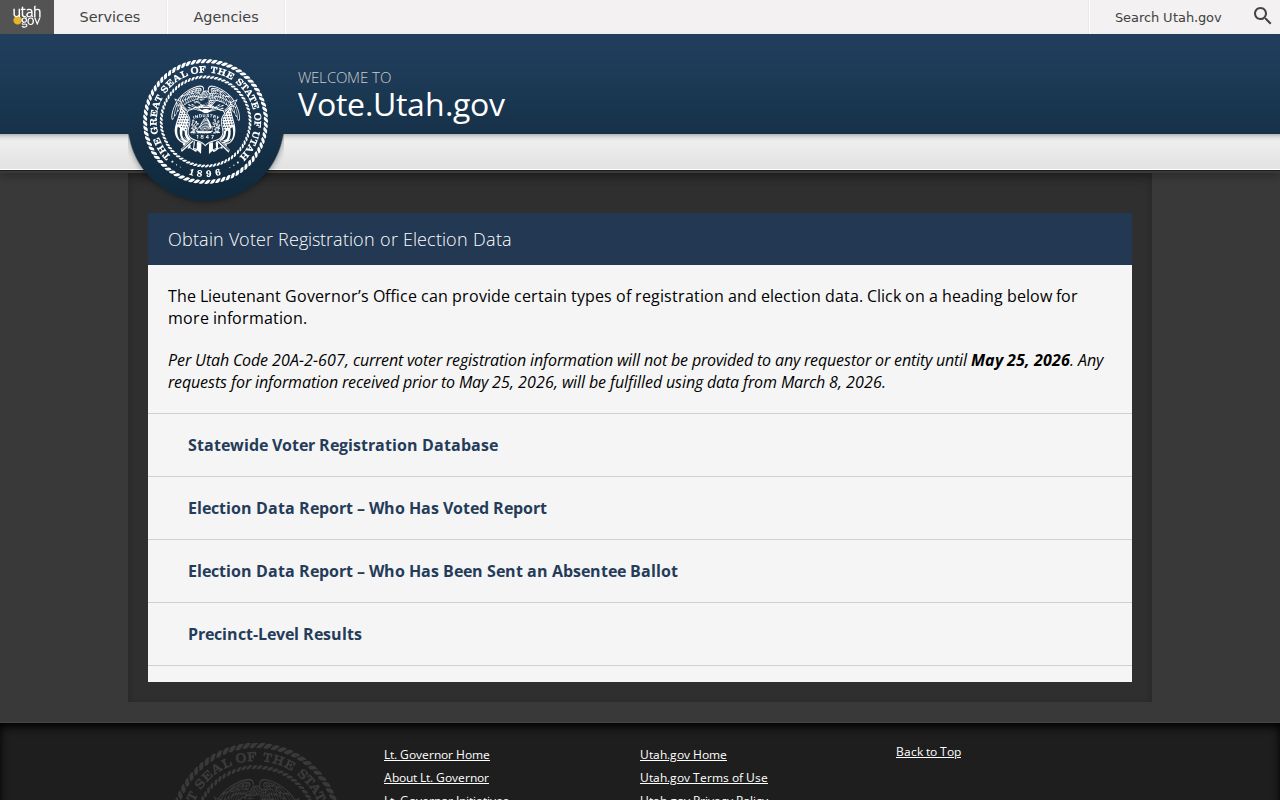
For Hurricane users, this source distinguishes the large statewide file from lower-cost election reports and the county-level Hurricane request path.
Hurricane Voter Data Use Limits
Public status does not make Hurricane voter data free of use limits. Utah Code Section 20A-2-603 requires a requester to protect the data, restrict it to authorized agents, and use or share it only for a purpose allowed by Section 20A-2-607. False pretenses, barred acquisition, prohibited use or sharing, and false certifications can lead to a class A misdemeanor, a civil fine, and false-statement liability under Section 76-8-504.
Other laws still apply. Utah prohibits stalking under Section 76-5-106.5, electronic communication harassment under Section 76-9-201, and identity fraud under Section 76-6-1102. Never use voter records to threaten, harass, impersonate, defraud, or harm a person. If misuse involves a Hurricane voter file, report it to Washington County Elections and the Utah Lieutenant Governor's elections office. Preserve the request, message headers, payment demands, phone numbers, and screenshots instead of confronting a suspected offender.
Lawful access has a narrow purpose. A public field remains bound by election-law certifications and anti-harassment rules. Access is not permission to target a Hurricane voter.
Why Hurricane Voter Status Changes
A Hurricane voter can appear inactive after not voting in two regular general elections and failing to respond to a county-clerk notice. The authenticated result explains that inactive voters do not receive mail ballots and directs them to contact the clerk or update their registration. Inactive does not mean that the record reveals how anyone voted. It describes the status of the registration and the clerk's maintenance process.
Utah's NVRA data dashboard publishes monthly counts for confirmation cards sent due to undeliverable mail or ballots, inactivity, or moves. It also tracks returned cards and registration updates. Removal-reason data begins in November 2025, with older data promised later, and reports are retained for two years. The state's registration statistics include county and party downloads plus historical spreadsheets for 2014 through 2026. Neither source provides a verified Hurricane city total.
Note: A stale status should be fixed through the personal lookup or county clerk, not inferred from an old downloaded voter file.
Hurricane Vote History, Not Choices
The phrase “voting history” is easy to misread. In Utah's standard voter data, it means the elections in which a person took part. It never shows a candidate choice or how a ballot was marked. A “Who Has Voted” report likewise lists details such as voter ID, legal name, residence, county, precinct or congressional district, voting method, ballot-processed date, and party or unaffiliated status. At-risk reporting omits identity.
This distinction is vital when reading Hurricane voter rolls. Participation is an administrative event used to run elections and maintain records. The secret ballot protects the selections made inside that event. No official voter file, lookup result, or participation report should be described as revealing a person's votes.
Hurricane's 2026 Privacy Transition
S.B. 153 changed Utah voter-record privacy in 2026. State officials sent notices to more than 300,000 affected Utah voters, and most records that had been private or withheld became public on May 25, 2026 unless a voter qualified for at-risk status. That shift explains why an older summary, form, or prior answer about Hurricane voter registration may conflict with today's public-data definition.
Use the official 2026 notice alongside the current code. The transition did not make every registration field public. Full birth dates, phone numbers, email addresses, identification credentials, citizenship-proof details, and protected-voter records remain private. It changed the standard public package while preserving a defined confidential core.
Historical Hurricane Election Records
Current lookup screens are a poor tool for tracing older Hurricane elections. The Utah State Archives holds voter-information pamphlets in Series 21810 dating from 1975, with public microfilm coverage listed for 1976 through 2002. Those pamphlets document what voters were told about elections, issues, and candidates, but they are not the same as a named historical registration roll.
No exact online series for Hurricane or Washington County poll books and registration registers was confirmed. The sound fallback is to ask both the Utah State Archives and Washington County Clerk, giving the election year, place, record type, and names sought. Hurricane is not the county seat, so historic county election material is more likely to be routed through St. George or the state archives than a Hurricane city counter.
That gap should remain explicit. Pamphlets can supply election context, while a clerk or archivist can determine whether a surviving poll book, register, or related county series is available for inspection.