
Which Hurricane Public Records Exist
Hurricane is not the Washington County seat, so its records do not gather at one counter. The city keeps council, planning, permit, code, police, cemetery, and municipal administration files. County offices in St. George keep land instruments, assessments, marriage files, elections material, county justice records, and jail information. Utah courts and state agencies hold other sets. The first task is to identify the agency that made or maintains the record.
| Hurricane record set | Keeper | Online reach | Access route |
|---|---|---|---|
| Hurricane deeds, liens, plats, surveys | Washington County Recorder/Surveyor | Current Hurricane dynamic search; Old Abstract, 1854–1992 | Hurricane viewer, phone, or counter |
| Hurricane ownership and assessment | County Recorder and Assessor | Separate Hurricane Recorder, Assessor, and GIS viewers | Hurricane web viewer or office |
| Hurricane district and justice cases | Utah Courts | Hurricane cases in Xchange; district CORIS coverage mostly complete by late 1998 | Hurricane paid web use, free court terminal, or clerk request |
| Hurricane marriage records | Washington County Clerk; Utah Vital Records for 1978–2010 abstracts | Hurricane county marriage search | Hurricane index; restricted certified copy when recent |
| Hurricane birth and death certificates | Utah Vital Records; Archives after transfer | Hurricane state coverage from 1905 | Hurricane eligibility and age limits apply |
| Hurricane police, jail, and corrections | Hurricane Police, county sheriff, Utah DOC | Hurricane agency-specific tools | Hurricane published fields or a focused agency request |
For Hurricane records, Utah GRAMA classifies agency material as public, private, controlled, or protected. Filing a Hurricane request does not open sealed or expunged cases, juvenile files, adoption proceedings, protected voter data, or restricted motor-vehicle data. Recent vital certificates also have eligibility rules. An open Hurricane index can identify a file while the certificate, image, or protected fields remain closed.
Accessing Washington County Deed Records
The Washington County Recorder/Surveyor keeps deeds, recorded instruments, cross-reference indexes, plats, surveys, and ownership maps for Hurricane land. Its current Property Search link was unavailable during research, so a failed web page should not be treated as proof that a record is missing. Call 435-301-7680 or use the counter at 111 E Tabernacle in St. George. The office can also supply copies and certifications.
The Recorder’s official page shows the current property-search route.
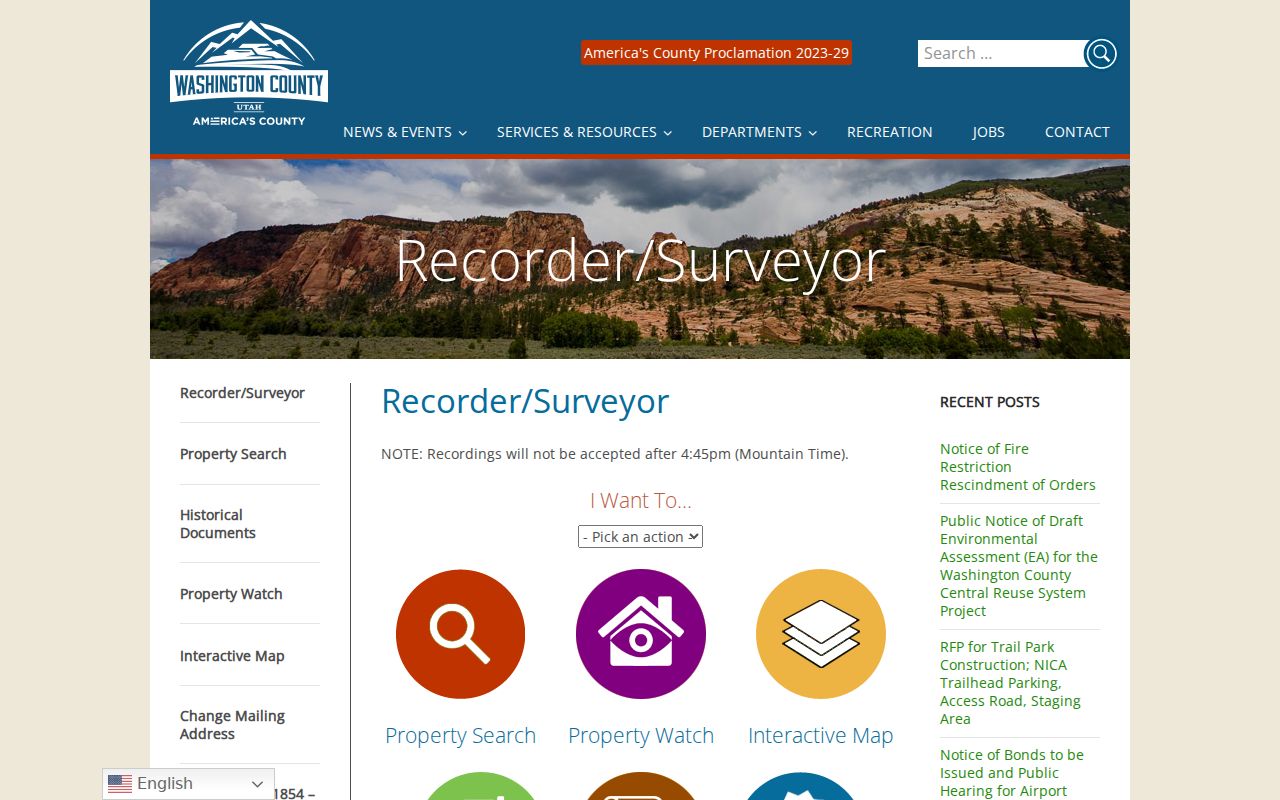
For Hurricane, the image is a source checkpoint, not a promise that the linked vendor application will load. Older Hurricane title research has a firmer boundary: Old Abstract condenses property history from 1854 through 1992. Its documented parcel data includes account number, parcel number, subdivision name, ownership type, an image, and an ownership-data link. Historical ownership plat maps add parcel lines and year-based ownership context.
Hurricane Property Records Use Three Views
County property evidence is split by purpose. The Recorder Viewer emphasizes owner information, reports, and mailing labels. The Assessor Viewer offers property reports, photos, and sketches. The broader GIS viewer adds county map layers, while Hurricane’s own standard maps provide local parcel, zoning, annexation, precinct, project-stage, and Dixie Springs address context. None of those map layers replaces the recorded deed.
The Washington County map inventory displays the separate choices.
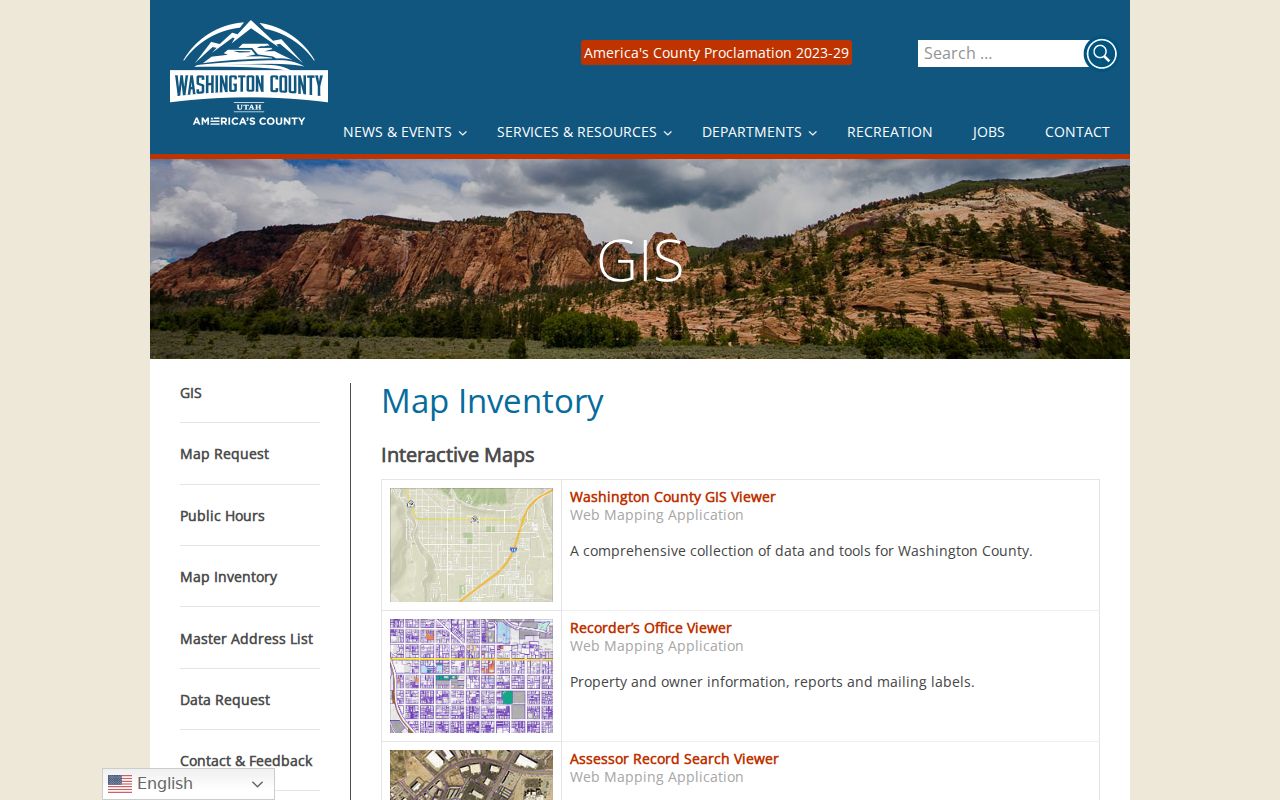
Use the Recorder for Hurricane title ownership, legal descriptions, plats, acreage, and document chains. Ask the Assessor at 435-301-7020 about Hurricane valuation and building characteristics. The Treasurer at 435-301-7720 handles tax bills, delinquencies, and mailing-address changes. A Primary Residential classification is tax evidence, not proof that the named owner lives at the site, because qualifying occupancy can support that classification.
Note: The Recorder Viewer’s mailing label may differ from the situs address, so confirm both fields in the live viewer or at the counter.
Searching Hurricane Court Records
Hurricane matters can belong to the Hurricane/La Verkin Justice Court, Washington County Justice Court, Utah Fifth District Court, or federal court. Utah Xchange holds public district and justice case information entered into CORIS. Most district courts were complete in CORIS by the end of 1998, but justice-court conversion dates differ. Older converted entries may be thin. Public electronic district filings from July 1, 2010 may have images available for purchase.
The Utah Xchange entry screen shows guest and account access.
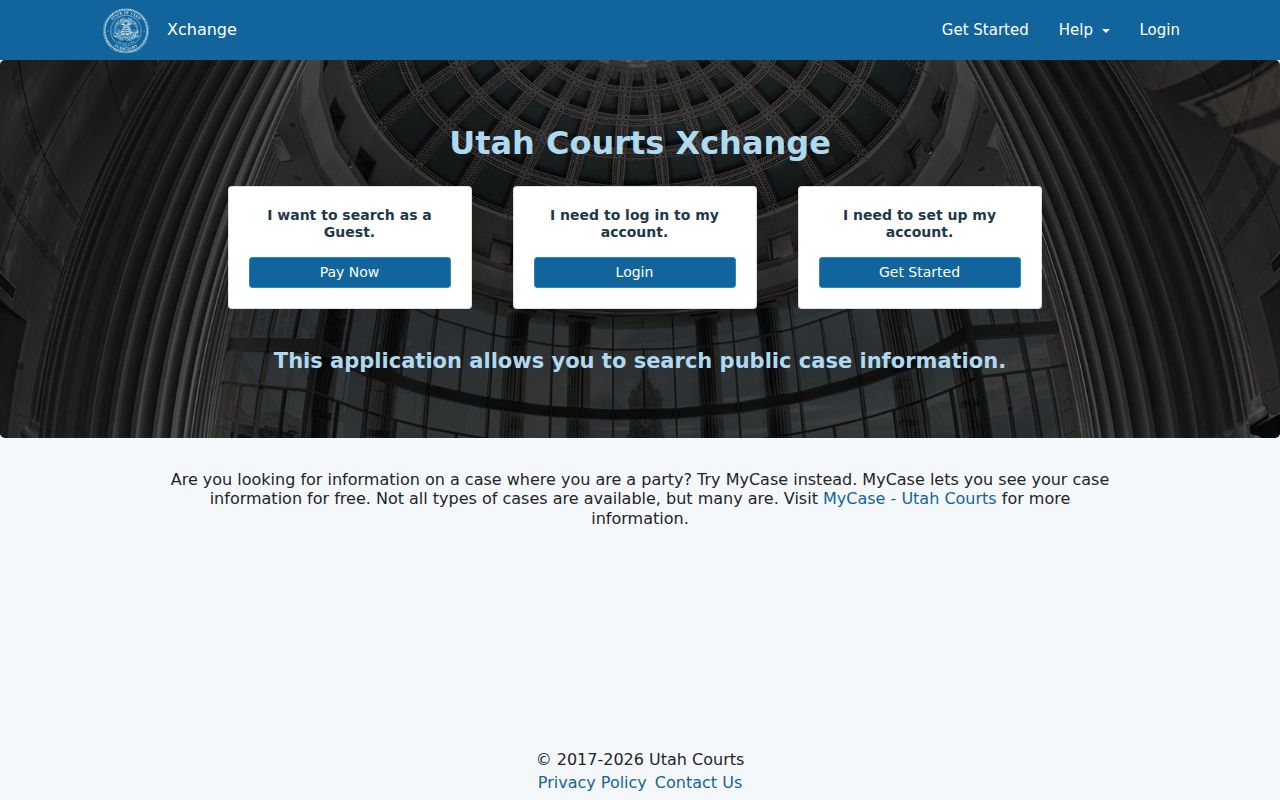
A Hurricane result may show party names, an address when available, judge, attorneys, case type and number, filed documents, hearings, minute entries, judgments, and outcome. Sealed and expunged Hurricane cases do not appear. Adoption and civil-commitment cases are sealed, juvenile matters sit outside Xchange, and parts of domestic cases may be private. Free Xchange terminals are available at most district courthouses and at the Utah State Law Library. Call before relying on a justice-court terminal.
| Xchange control | Type | Use or limit |
|---|---|---|
| Hurricane guest “Pay Now” | Access mode | Public pay-as-used route for Hurricane cases |
| Hurricane account “Login” | Access mode | Subscriber route for Hurricane cases |
| Hurricane “Get Started” | Access mode | Creates an account or subscription for Hurricane searches |
| Hurricane case number, party name, court location | Search concepts | Hurricane live fields sit behind JavaScript or login |
| Hurricane District and Justice Court scope | Filter concept | Include justice courts for Hurricane citations |
Note: A free courthouse terminal may show the same public case data without Xchange web charges, but call the court before traveling.
Hurricane Vital Records Have Limits
Utah Vital Records maintains state birth and death certificates from 1905 onward and marriage and divorce abstracts for 1978 through 2010. Washington County Clerk is the marriage route before 1978 and after 2010. A divorce outside the state abstract span belongs with the district court where it was final. The abstract is not the same as the court docket, pleadings, or decree.
The Utah certificate page sets out ordering and coverage rules.
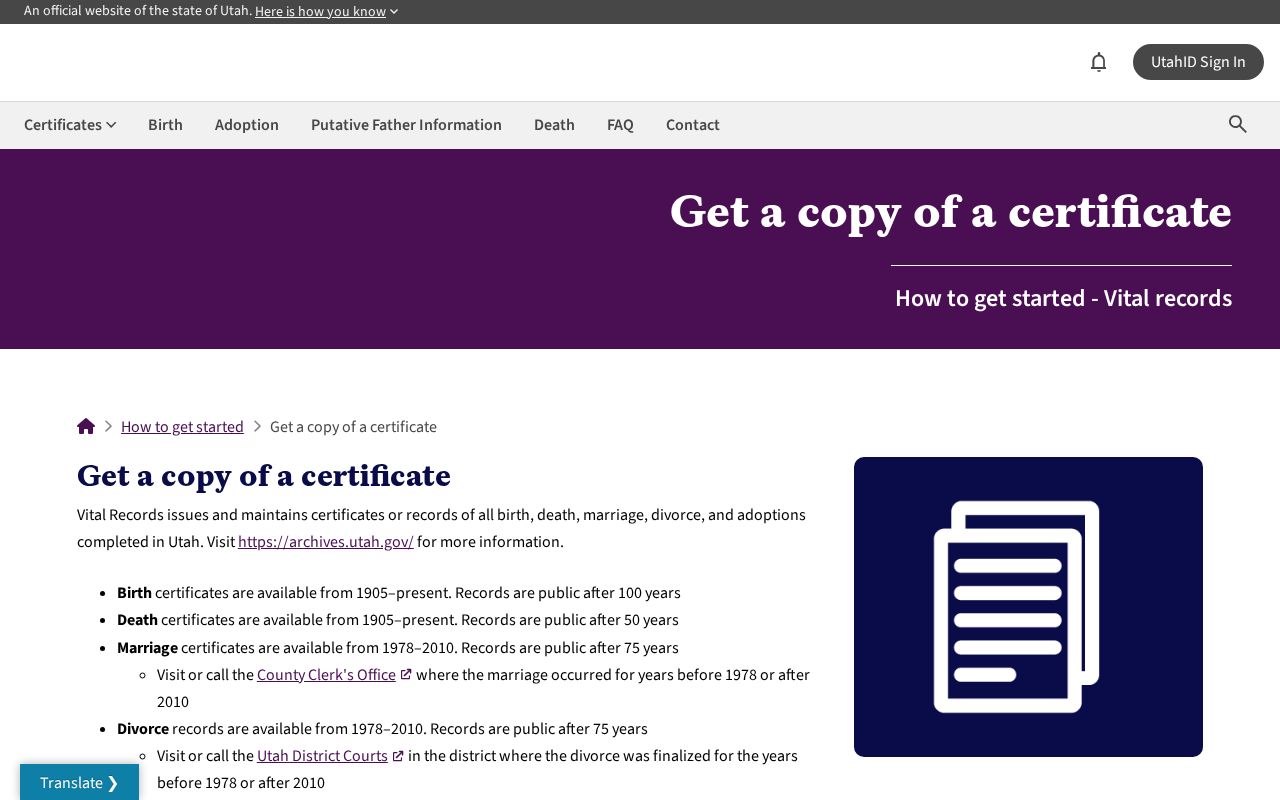
Hurricane birth records become public after 100 years, death records after 50 years, and marriage and divorce records after 75 years. Before then, qualified Hurricane applicants must show identity, relationship, or legal need. Washington County marriage certified-copy requests require the front and back of government ID. Historical researchers can turn to Utah Archives after transfer, including the public Washington County birth registers for 1898 through 1905.
Certificate eligibility matters. Finding an index entry does not grant access to a recent certified certificate. Apply through the named custodian and provide the required proof.
Note: Utah Archives, county marriage files, and district court dockets fill different gaps; no one vital portal covers every Hurricane event.
Hurricane Public Records Offices
The correct desk depends on who created the file. Hurricane City Recorder handles city minutes, ordinances, contracts, oaths, resolutions, and city GRAMA files. The Washington County Recorder/Surveyor and Clerk share the county complex in St. George, but their roles differ. The Clerk handles marriages, elections, passports, and county GRAMA. It is expressly not the Clerk of Courts.
Washington County Recorder/Surveyor
111 E Tabernacle
St. George, UT 84770
435-301-7680
Washington County Clerk
111 E Tabernacle
St. George, UT 84770
435-301-7220
Hurricane/La Verkin Justice Court
Justice cases and local court requests
435-635-4072
County counter work usually requires a trip to St. George because Hurricane is not the county seat. For a city file, use the city custodian rather than sending it to the county. Court, police, and county land requests should likewise go to their own keepers. That routing choice prevents the common response that the receiving office does not maintain the requested record.
Hurricane Police and Corrections Records
Hurricane Police accepts records requests at records@hurricane.utah.gov or at 90 S 700 W. Its form asks for the incident location and date, person involved, requester relationship or authority, desired copies or certification, and whether photos or body or dash video are sought. Police reports can contain investigative, victim, juvenile, or other protected material, so a released copy may be redacted.
The Utah Department of Corrections keeps a separate statewide offender search. The official DOC lookup shows the state corrections route.
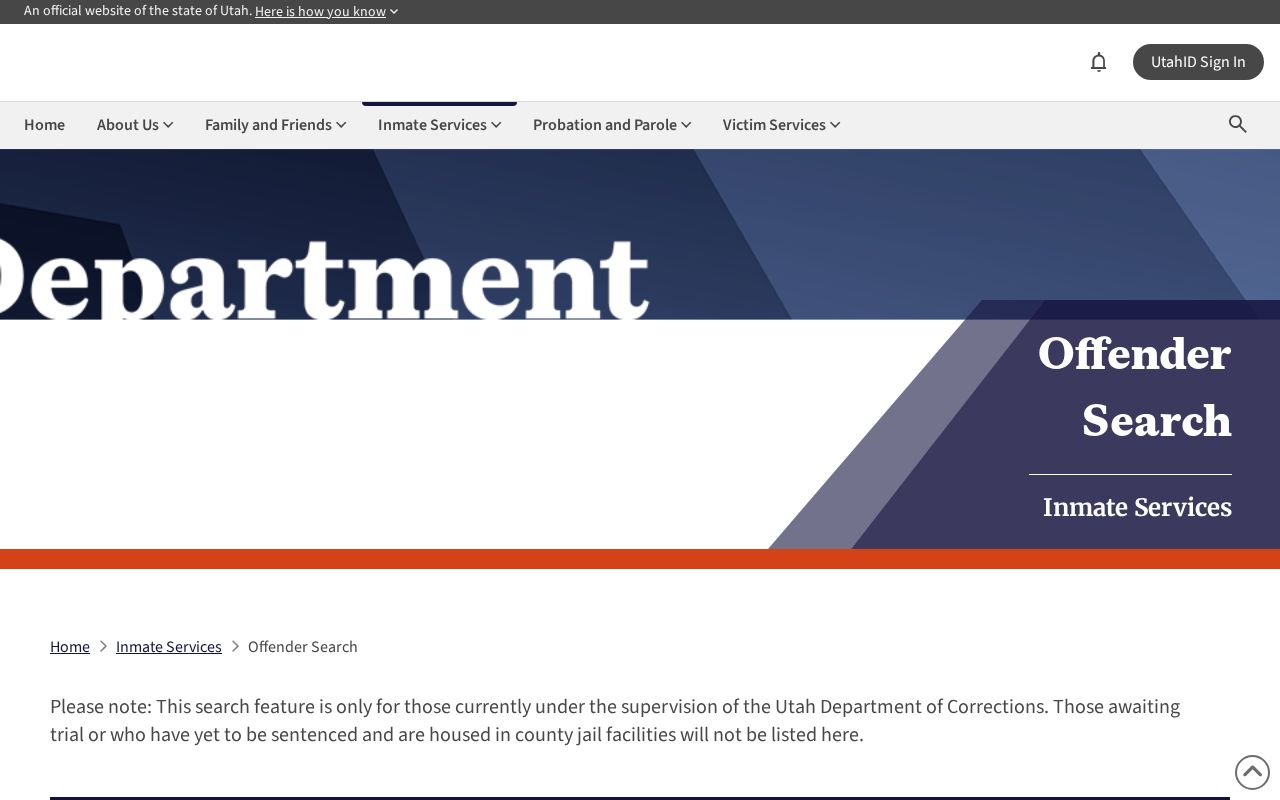
The DOC search can use a Hurricane name or offender number and returns the public custody, location, status, and sentence-related data supplied by the agency. Hurricane-area booking data comes from the Washington County Sheriff, not DOC. A booking or charge is not a conviction. For a releasable report beyond published booking fields, contact the sheriff’s records unit or file a narrow GRAMA request with that agency.
Hurricane Records Before 4:45
A useful local detail can save a wasted trip: the Washington County Recorder stops accepting recordings at 4:45 p.m. Mountain Time. That cutoff concerns presenting a document for recording, not simply asking to inspect an index or request a copy. Still, anyone combining research with a filing should plan for the earlier deadline and call first when the web portal is down.
The distinction also matters for older Hurricane land evidence. A current portal failure does not close the counter, and Old Abstract has documented coverage from 1854 through 1992. Military-discharge certified copies are free, though access restrictions may still govern who can receive sensitive discharge material.
Note: Call the Recorder before a late-afternoon visit, especially when the task includes filing a document rather than viewing an existing record.
Hurricane Record Fees Changed in 2026
Fees vary by office and product. Effective May 6, 2026, Washington County announced a $45 fee for an applicable recording and a $10 recorded-document redaction fee. A separate subdivision-map review charge began January 2, 2026 at $10 per new tax account, with a $300 minimum per subdivision map. Those are filing or review costs. They are not routine deed-copy prices.
Hurricane-related county GRAMA copies cost $0.25 per photocopied side. Certification is $4 per document plus $0.50 per page, and audio costs $10 on a CD or flash drive. The justice-court form lists $0.25 photocopies, $4 certification per document plus $0.50 per page, $15 for half-day audio or a storage unit, and $21.20 per hour for research after the first 15 minutes. Utah GRAMA allows actual-cost fees and prepayment, but it also provides Hurricane waiver grounds.
Note: Ask for an estimate and choose inspection when practical, since certification, staff research, media, and filing charges serve different tasks.
A Public Index Is Not a Copy
The word “public” describes legal access to a record or field. It does not mean that every image is free, every certificate can be issued to anyone, or every detail appears online. Xchange omits sealed and protected cases. Vital-record copies stay restricted for set periods. A land index may expose a name, parcel, or document reference while the actual instrument must be viewed or ordered from the Recorder.
Use an index as a locator. Write down the case, parcel, account, certificate, or document number, plus the names and date range. Then ask the custodian for the record itself. That method also reduces search time and helps the office give a clear fee estimate.
Protecting Data in Hurricane Records
GRAMA does not create a broad right to erase an accurate deed, docket, or meeting record. Privacy relief is tied to a statute and to the record at issue. Ask the keeper whether redaction, correction, or a private, controlled, or protected classification applies to the exact field. Washington County’s recorded-document redaction process addresses unlawfully included personal identifiers, but it does not erase a valid ownership chain.
Utah Safe at Home offers an eligible survivor a substitute address and mail-forwarding process across qualifying government records. It is prospective and does not promise removal from every old file. Qualifying at-risk voters use a separate county-clerk path. Washington County Property Watch can alert an owner to later recorded activity, but it does not hide the land index or block a filing.
Note: Privacy options are record-specific, so identify the exposed field and ask the correct Hurricane, county, court, or state custodian about it.
Terms Behind Hurricane Record Access
Records offices use short terms that can change what a requester receives. These definitions help separate a search result from the proof behind it.
- Hurricane custodian
- The government entity that maintains the record and decides access under the governing law.
- Hurricane index
- A locator with names and reference data. It may not include the full document image.
- Hurricane certified copy
- A copy authenticated by the keeper as a true copy of the official record.
- Hurricane exemption
- A legal basis for withholding a record or a part of it from disclosure.
- Hurricane redaction
- The removal or masking of protected content while the releasable part is supplied.
A good request states whether inspection, a plain copy, or a certified copy is needed. Certification costs more and should be requested only when the official authentication serves the user’s purpose.
Requesting Hurricane Public Records
Utah’s Government Records Access and Management Act lets any person request a public record from the entity that maintains it. Under Utah Code §63G-2-204, a written request includes the requester’s name, mailing address, daytime phone when available, and a reasonably specific description. Ordinary responses are due as soon as reasonably possible and no later than ten business days. A qualifying expedited public-benefit request is due in five business days.
- Name the Hurricane keeper. Send city files to Hurricane City, county files to the correct county department, and court files to the court that filed the Hurricane case.
- Check the Hurricane index. Save useful case, parcel, account, or document numbers before asking staff to retrieve a Hurricane copy.
- Describe the Hurricane record. Give names, address or subject, date span, department, desired format, and whether Hurricane inspection or copies are wanted.
- Choose a Hurricane channel. Washington County accepts its form by email at grama@washco.utah.gov, fax at 435-301-7249, mail, or counter. Hurricane City accepts city GRAMA in person or by email.
- Set a Hurricane cost limit. Ask to inspect first when price matters, state the maximum authorized cost, and claim a Hurricane waiver only on a supported statutory ground.
- Use Hurricane appeal rights. A denial should identify what was withheld, cite the authority, and explain Hurricane appeal steps. Appeals begin with the chief administrative officer.
The Washington County GRAMA route lists the county channels. The Utah Open Records Portal can transmit a state or local request and help locate a records officer, but it is not a combined database. If an office says it does not maintain the file, redirect the request rather than broadening it.
Lawful personal use. Open records may support family research, estate work, civic review, or fraud checks. Utah law does not permit using them to stalk, harass, threaten, impersonate, or defraud another person.